

Full Disclosure. No half truths.
Let’s be clear about clean.
‘Non-toxic’, ‘natural’, ‘allergen free’.
The cleaning industry is full of reassuring promises, but what do these claims actually mean? What’s really inside the bottle, and what aren’t we being told?
Clean-washing is the new greenwashing, and we’re here to cut through the BS, challenge the claims and expose the gaps in what manufacturers have to disclose.
Through our Clear Label Manifesto, backed by national consumer research, we’re lobbying Government, regulators and the homecare industry for full ingredient transparency, clearer labelling and greater accountability for the claims they make.
Household products shouldn’t be formulated as though human contact doesn’t exist. Yet there’s still too little transparency in homecare.
We use these products on our clothes, bedding, surfaces and around our families, but we’re rarely told the full story of what’s actually in them. We think you should know.
1. What aren’t we being told and what is the Clear Label Manifesto?
Through our Clear Label Manifesto, we’re calling on Government, regulators and the homecare industry to raise the bar on ingredient transparency. Full disclosure, clearer labelling and greater accountability for the claims manufacturers make.
Because consumers have a right to know what’s in the products they bring into their homes.
Isn’t ingredient labelling already regulated?
Yes. But that doesn’t mean consumers get the full picture. Unlike beauty products, household cleaning products aren’t generally required to list every ingredient individually on the packaging. Our national research found that 67% of UK adults mistakenly believe every or most ingredients already have to be named.
What does your research reveal?
We surveyed 2,004 UK adults. 85% believe cleaning manufacturers should be required to list all ingredients. Yet when shown a standard cleaning product ingredient declaration, only 21% understood it correctly.
It’s a striking disconnect between what consumers think they’re being told and what they actually understand.
What exactly do you want to change?
KNOW WHAT’S IN IT. Full, accessible disclosure of the ingredients intentionally used in household and laundry products.
KNOW WHAT IT MEANS. Clearer definitions and explanations of claims such as “natural”, “plant-based”, “non-toxic”, “non-bio” and “dermatologically tested”.
KNOW WHAT MATTERS. Greater clarity around fragrance allergens, skin sensitisers and officially identified substances of concern.
Are you saying conventional cleaning products are unsafe?
No. We’re saying consumers deserve facts, not fear or marketing spin. Natural doesn’t automatically mean safe. Chemical doesn’t automatically mean harmful. What matters is the ingredient, its concentration, how it’s used and the evidence behind it.
What happens next?
We’re taking our research to policymakers, regulators, consumer organisations and the wider homecare industry to push for stronger transparency standards.
Beauty has raised the bar on ingredient transparency. Why should homecare be left behind?
Join our movement.
2. What does your homecare label actually tell you?
Not necessarily the whole formulation. Household detergents are labelled differently from skincare.
Under GB detergent regulations, precise formulation details do not have to appear on the front or back of pack. Certain ingredient groups can instead be declared by category and within broad concentration bands:
- less than 5%
- 5%–15%
- 15%–30%
- 30% and over
Which is why you may see:
“<5% anionic surfactants, non-ionic surfactants; perfume; preservatives.”
It is compliant but how much does it actually tell you? Which surfactants? Which preservative? What does each ingredient do? Why has it been used? What is sitting behind the word “perfume”? We think consumers should be able to understand more.
So we tell you what is in our formulations and, importantly, why it is there.
3. Fewer ingredients. No less performance.
Our proprietary formulations were developed from scratch by our Chief Scientist. No inherited formula. No default ingredient list. No assumption that because something has always been used, it needs to be there.
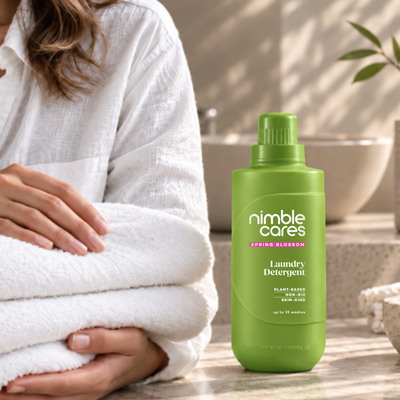
We prioritise high-performing ingredients from plant sources, chosen for what they do and how they work together. The result? Our laundry formulas use less than half the number of ingredients found in many formulations from leading brands, while delivering comparable cleaning performance.*
As our Chief Scientist Von Sy, a former Unilever R&D Scientist, explains:
“Each ingredient has a job to do. An effective deep cleanse doesn’t have to mean a huge number of aggressive ingredients; it’s about choosing ingredients intelligently and understanding how they work together.”
Because adding more doesn’t automatically make a formula better. Knowing exactly why each ingredient is there does and because clothes, bedding and towels spend prolonged periods against our skin, what we leave out matters alongside what we put in.
4. What do our claims actually mean?
If we put a claim on our packaging, you should be able to understand exactly what we mean by it.
Plant-based
We prioritise high-performing functional ingredients from plant sources, with ingredients derived from coconut, corn, rapeseed, sugar cane and other plant feedstocks used across our formulations.
Skincare grade
Formulated with the same consideration given to products made for skin and credited by the skincare industry. Our ingredients are carefully selected with skin contact in mind, alongside cleaning performance. Our founder washes her hair and face with laundry detergent, this is how much she believes in it.
Dermatologically tested
Our formulas are dermatologically tested, with skin contact considered as part of how we formulate.
Non-bio
Our laundry formulas are non-bio and formulated without enzymes, using purposeful plant-based ingredients instead.
Fragrance, your choice
Our scented formulas are created without fragrance allergens so you can have scent without the allergens we deliberately formulate out, or there is also a Fragrance free alternative.
5. What do we leave out and why?
We talk about “hidden toxins”. By “hidden”, we mean ingredients that aren’t always obvious and don’t HAVE to be obvious on homecare ingredient labels but are harmful.
No enzymes.
Effective stain-removing ingredients used in biological detergents. We choose to clean without them, using carefully selected surfactants and other purposeful ingredients instead. It also means our formulas are suitable for fabrics such as wool and silk, which typically require enzyme-free care.
No MI/MIT or MCI/CMIT, no BIT, no OIT
Methylisothiazolinone (MI) and methylchloroisothiazolinone (MCI) are preservatives used to help protect water-based products from microbial growth but are also well-known contact allergens. We don’t use these in our formulas. Instead, where a preservative is necessary, we use alternatives such as phenoxyethanol. Chosen to protect the formula from microbial growth without relying on these isothiazolinone preservatives.
No optical brighteners.
They don’t remove stains. They use light to make fabrics appear whiter and brighter. We’d rather clean the fabric than create the appearance of clean.
No dyes.
They add colour to the product, not cleaning power. If it doesn’t help us clean, we don’t believe it needs to be there.
No parabens.
Preservatives used in some cosmetic and household formulations. We formulate without them.
No known hormone disruptors.
We formulate without substances identified as endocrine disruptors. Endocrine-disrupting chemicals (EDCs) are substances that can interfere with the body’s hormone systems. Exposure to certain EDCs has been associated with effects on reproductive health, development and metabolism.
No chlorine bleach
We formulate cleaning performance through alternative surfactant and active systems.
No SLS.
Sodium Lauryl Sulphate (SLS) is a highly effective surfactant used to lift oils and dirt, but it can be harsh on skin, particularly at higher concentrations or with repeated exposure. We formulate without SLS, choosing alternative surfactants to deliver the cleaning performance we need.
6. And what do we use?
This matters just as much.
PARETH-7
What is it? A non-ionic surfactant.
Where does ours come from? Coconut-derived feedstock.
What does it do? Helps lift oily and greasy soil from fabrics so it can be carried away in the wash.
Why do we use it? Because surfactants are fundamental to effective cleaning, and different surfactants tackle different types of soil.
TRI-SODIUM CITRATE
What is it? A citrate salt.
Source: Derived from fruit/corn feedstocks in our formula.
What does it do? Helps manage minerals in water, supporting detergent performance.
Why do we use it? Cleaning chemistry works differently depending on water hardness. Citrates help the cleaning system work more effectively.
GLYCEROL / GLYCERINE
What is it? A humectant widely used in personal-care and skincare products.
Source: Plant-derived in our formulations.
What does it do? Helps attract and retain water.
Where do we use it? In selected nimble cares formulas, including laundry and hand-care applications.
PHENOXYETHANOL
What is it? A preservative.
What does it do? Helps protect suitable formulations against microbial contamination.
Why do we use it? Because some water-containing formulations require preservation to remain stable throughout normal storage and use. We don’t hide it, we explain it.
ESTERQUAT AMMONIUM SALT
Source: Rapeseed-derived feedstock in our Fabric Conditioner.
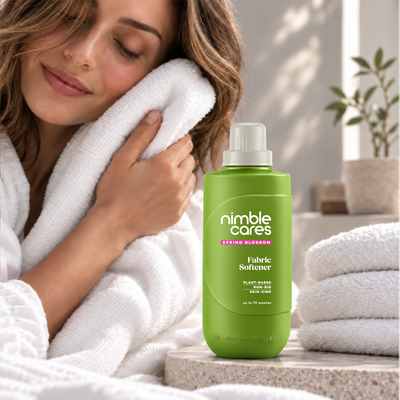
What does it do? Acts as a fabric-conditioning ingredient, helping reduce friction between fibres so fabrics feel softer.
Why do we use it? Because softness should come from purposeful formulation rather than unnecessary colourants, enzymes or heavy additional ingredients.
LACTIC ACID
What is it? An organic acid.
Source: Fermented corn in our Multi-Purpose Cleaner.
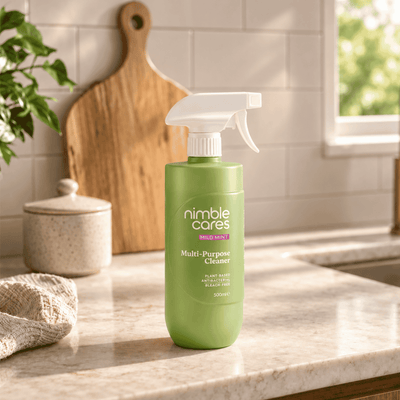
What does it do? Contributes to the antibacterial performance of the finished formula and helps tackle mineral build-up such as limescale.
Why do we use it? It enables us to deliver antibacterial cleaning without chlorine bleach.
ETHANOL
What is it? Alcohol.
Source: Corn-derived in our formulas.
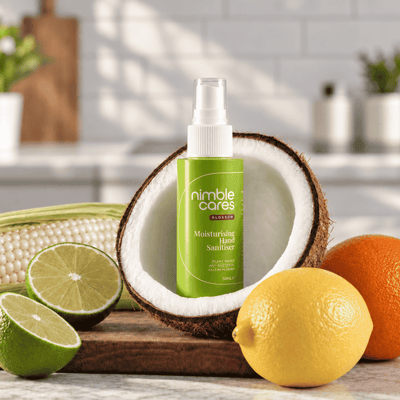
What does it do? Its role depends on the product. In our Multi-Purpose Cleaner it contributes to cleaning performance. In our Hand Sanitiser, a much higher concentration of ethanol provides the primary sanitising action.
7. Yes, some ingredients have chemical-sounding names
A long or unfamiliar ingredient name doesn’t automatically make something harmful. Everything is made of chemicals plants, water, our skin, the air around us. So “chemical-free” isn’t a meaningful standard. The question is which chemicals, what they do, and why they’re there.
We don’t believe effective cleaning needs to rely on harsh or unnecessary ingredients. We choose purposeful ingredients for their function, how they work together and whether they meet the standards we’ve set for our formulas.
So rather than judging an ingredient by how its name sounds, we ask:
What is it? Where does it come from? Can it cause harm? What does it do? Why is it there?
8. Fragrance: one word. Potentially many ingredients.
“Parfum” or “perfume” can make fragrance sound like a single ingredient. It isn’t. A fragrance composition can contain multiple aromatic substances. Some fragrance substances are recognised contact allergens. Detergent regulation therefore requires specified fragrance allergens to be individually declared when they are present above the relevant threshold in the finished product. Not appearing on the label does not necessarily mean an ingredient is absent. It can mean it is present below the declaration threshold.
Where we use fragrance, we work with the underlying fragrance specification and look at what is actually in it. Our new fragrance system has been specifically developed without the fragrance allergens we screen against. And where you would rather have no fragrance at all, we offer fragrance-free options.
Because these are different things:
- Fragrance-free = no added fragrance.
- Without fragrance allergens = fragrance is present, but formulated without the specified fragrance allergens covered by our standard.
We think brands should make that distinction clear.
9. The bottom line
We believe every homecare formula should have a fully transparent ingredient list. Cleaning products don’t exist in isolation. They end up on the clothes we wear, the sheets we sleep in and the surfaces we live around.
What’s in them should not be a mystery
#ItsTimeToComeClean #DishTheDirt